
THE CHALLENGE OF LOOKING AT THE PAST WITHOUT BEING TRAPPED BY IT
Looking back at the Fall 2005 runways, I find myself reflecting on the inspirations of that era and questioning how they remain relevant today.
To understand this, we need to distinguish between two perspectives:
- The inspiration/mood-board: the creative vision driving designers.
- The realization/clothes: how those ideas are materialized into garments.
Back in Fall 2005, designers drew extensively from historical influences, particularly the Empire, Victorian, and Edwardian eras. Runways were infused with romanticism, regal elements, and structured elegance, reinterpreted through a modern lens.
To quote Ann Demeulemeester, “I was feeling something poetic and fragile. A bit like Victorian innocence. Beautiful, but contemporary, too.” (Vogue Runway)
Valentino embraced Russian imperial references, layering brocade jackets and jet-beaded capelets with lace frothing blouses, while Galliano for Dior mixed Napoleonic collars, cutaway tailcoats, and biker jackets, proving that heritage could be reshaped into something new.
Even Stefano Pilati at YSL referenced 17th-century Flemish paintings, infusing restraint with rich detailing, stating, “We want self-respect, and not to show our wealth so much.”
Across these collections, the past was not simply replicated: it was reinterpreted, reshaped, and repurposed for a different time.
WHY STANDARDIZATION WORKS FOR CLOTHING, BUT NOT FOR PERSONAL BRANDING
Think about something as simple as a T-shirt.
Millions of people wear T-shirts, yet each person styles them differently. Some wear them oversized, others fitted. Some tuck them in, others layer them under blazers. Despite the same base item, the outcome is never identical.
Similarly, many people love rock music, but each person has a different emotional connection to it. For some, rock music is tied to childhood memories, for others to rebellion, for others to a defining life moment.
This is why standardization works for mass clothing production—but not for personal branding.
While mass fashion operates on replication, personal branding is about distinction.
If you have ever bought something that looked stunning on a model, a friend, or a stranger but did not feel right on you, you have experienced this first-hand. Was it just a piece of clothing—or were they selling you a lifestyle, a status, an identity?
You can buy clothes, but you cannot buy confidence.
You can buy an accessory, but you cannot buy personality.
Personal branding forces you to ask deeper questions, not just about what you wear, but why you wear it. It is about self-awareness, not just aesthetics.
THE ART OF LOOKING AT THE PAST WITH A PERSONALIZED EYE
To understand heritage, we must view it like ancient history: with curiosity, rather than judgment. The days of ipse dixit are long gone; we now know that everything is an interpretation, valid only for its time. As Heraclitus would say, panta rhei—everything flows.
Just as designers reinterpret history through their own vision, we must filter our personal branding through our own lens, shaping what serves us and discarding what does not.
Imagine taking a photograph with a unique camera: your perspective and creativity are one of a kind, and so is the final image.
The same applies to your personal brand: It is not about replicating what works for someone else. It is about making it yours.
When your space feels too small, do not shrink, expand.
When a path feels too narrow for your energy, create new ones
Personal branding is not about fitting into a mold: it is about defining yourself on your own terms. And to do that, you must be willing to look at the past, understand it, and then make it your own.
BECOMING THE MARKETER OF YOUR IMAGE
Companies spend years refining their brand strategy—positioning, storytelling, audience engagement. Why should it be different for personal branding?
The realization of our time is that our image is a product, a message we put into the world. And just like a business, our success depends on strategy and clarity.
You are the marketer of yourself, and before you implement any changes, you need to understand your own identity.
Ask yourself:
- What parts of my personal style or branding come from heritage?
- Am I following a trend, or is this an intentional choice?
- How do I reinterpret the past in a way that feels relevant to me today?
By taking this strategic approach, you are not just curating an image—you are building a brand that is timeless, authentic, and uniquely yours.
WHAT IS NEXT?
The concept of reinterpretation is powerful, but how does it translate into reality?
During the next Brand & Beyond meeting in Dubai on March 7th, we will explore real-life examples of how reinterpretation shapes fashion, branding, and personal identity. Through case studies and discussions, we will analyze how heritage and past influences can be transformed into something new and deeply personal.
If you are curious about how to integrate legacy and innovation in your own personal brand, this is the conversation for you.
Subscribe to the website and join the Brand & Beyond community on Meetup to be part of the discussion.
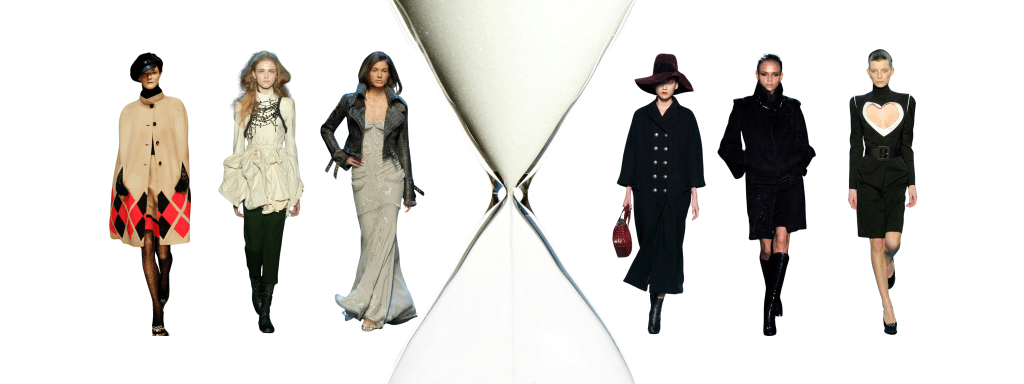
Valentino, Ann Demeulemeester, Christian Dior, Louis Vuitton, Gucci, Yves Saint Laurent
Fall 2005 – Vogue Runway
 Genny Bi Studio